When you want to institute a change in your life by changing your behavior, whether it is by actively taking something away, (i.e. less eating, less drinking, less time online), or by adding something, (more time at the gym, practicing meditation), an optimist’s perception, (“it’ll be no problem”), is represented by the following picture.
You just take the first step, and then climb ‘away’ from the initial starting point of your decision, until you you have moved far away from where you began.
For many people the optimist’s stairs lead to disappointment, as there is no way to understand the phenomena of ‘backsliding’, except as return to the beginning.
This next picture represents the way people who struggle to hold onto a change may experience life, as a set of steps that always return to the same point.
Climbing these stairs can bring feelings of cynicism, resentment, impotency, anxiety, paralysis, and the development of a pessimist’s attitude (“it’ll never work”) towards self change.
The final picture represents a third way of looking at life, as a set of stairs that spiral around a central point. The central axis in this set of stairs represents the central, ‘given’ aspects of a person’s character that are always there, no matter how far one may climb. On these stairs you are always you, just ‘further along’.
Setbacks, backsliding, and re-starts should be viewed as part of the process of solidifying change, and if you treat yourself with compassion in those moments of ‘not again…’, you will make it less difficult to take another step on the stairs. This is the realist’s attitude towards self-change.
When you make the decision that you want to introduce something new that is ‘good for you’ into your life – will you be able to follow through? Your intent will work as the instigator of the process; but you’ll still need a method to help you integrate the new activity, to carry through and make real what has started as ‘just an idea’.
Just because something may be good for you, like a particular diet, a fitness plan, a school course, or a stress reduction technique like the Simple Reset, does not mean that you will find a way to actually include it in your life.
Perceived value may have brought you to the initial decision to try something new, but the energy to carry on in this new direction is not a given, no matter how much you know that it would be good for you.
Though willpower is often thought of as an enviable psychological trait rooted in the invisible world of your mind, recent studies have shown it is governed by similar energetic processes that power your body’s other systems.
Early in the day, with proper rest, and nutrition, the maximum amount of your willpower will be available to you. However, as your day continues, and especially if you have made many decisions that involve compromises between ‘wants’, (i.e. I was nice to my friend/co-worker, though I really wanted to be angry, or, I didn’t take a second cookie at lunch), your willpower reserve drains like the energy in a battery.
Each time you made a choice or compromise of some sort during the day is the same as a ‘use’ of your battery. The more decisions, no matter how small, the more the battery drains.
A normally stressed day for most people sends them home with very little willpower left to concentrate on something new, like a meditation practice, a book, or a new eating regimen. This is why diets invariably fail at night, and the bag of snacks that you easily walk past at six, ends up in your hands at ten.
An interesting ‘trick’ to manage the inevitable drain of the willpower reserve, is to take the ‘decision’ making out of the daily process. Schedule your new activity at a time when you have willpower.
Want to practice a short, 3-minute stress reduction technique? Program your phone’s alarm to ring at a certain time during the day, and schedule your daily calendar so that you’ll be free at that time. The best times would be early in the day, immediately after coffee break or at the end of lunch.
If you wait till you ‘feel like it’, or until you ‘have time’, then you must rely on having enough willpower to make and hold onto the choice in the face of all distractions.
One time daily is enough to begin to build a lifetime health practice like the Simple Reset. Don’t wait till you have the time, till the evening, till all else is taken care of. Schedule it.
Further reading: Baumeister, R., & Tierney, J. (2011) Willpower: Rediscovering the Greatest Human Strength. New York: Penguin Press.
Want to learn an effective shortcut to making a lasting change in your self, your beliefs, behaviors, and the perceptions others have of you?
The traditional method involves an honest introspection of who you are and how you want to be different. Using this method, eventually the ‘outside’ you matches your inside attitudes and beliefs as you manage to change yourself, and eventually others will begin perceive you as you truly ‘are’. As an example, once you stop feeling shy, you will no longer appear shy to others, and they will treat you as though you are confident. This way can be described as ‘from the inside, out’.
The shortcut method involves acting on the outside the way you want to perceive yourself on the inside. Moving confidently leads to others reacting to you as if you were confident, leading to confidence. This way can be described as from ‘the outside, in’.
The outside in method is particularly effective when used to change how one communicates through body language and movement.
A six-week course in how to walk as though you shouldn’t be messed with has been shown to have a longer lasting effect on predator’s perceptions of vulnerability in potential victims than a six-week course in self-defense. (Book, Costello and Camiller 2013)
This maybe is because a six week course in self defense is not of long enough duration to change a person’s deep perceptions of their own ability to defend themselves, where as just learning to change one’s walking style doesn’t require a fundamental change in who one thinks they are.
You walk ‘as if’, not as ‘really are’.
In the following short clip a group of students are practicing stride lengthening in our Thinking Self Defense training.
Like the hunting lions described in our previous post, There are Lions out there, human social predators rely on their eyes to give them cues on choosing a potential victim.
An individual’s manner of moving can influence the perceptions of observers. Studies have shown that movement cues can reveal aspects of personality, life satisfaction, and sexual orientation. Body language is also symptomatic of an individual’s level of vulnerability – indicating dominance or submissiveness, powerfulness, self-confidence, vulnerability to assault, and history of physical and psychological injury.
As this applies to self-defense, research has directly tied specific movement cues found within an individual’s manner of walking to the likelihood of being victimized through assault.
If your way of walking includes the following ways of moving, you are likely to be seen as more vulnerable to attack.
Short strides
Lifting or shuffling steps
Constrained (tight) shoulder and arm movement
Constrained hip movement
Hesitant or slow pace
Confusion or distraction
Impaired walk (by injury or clothing)
However, if your way of walking includes the following ways of moving, you will be seen as less vulnerable to attack.
Lengthened stride
Swinging foot placement
Swinging arm movement
Unconstrained torso/hip movement
Direct pace
Attentive
Unimpaired (full body) movement
In a study by Book, Costello and Camiller (2013) this second set of movement cues is found to be effective in conveying a perception of assertion and less vulnerability to a group of criminals who were serving time for crimes involving physical assault.
Like animals in ‘nature’, human social predators seek signs that signal vulnerability in a potential target in order to increase the likelihood of a successful attack. Movement cues that signal you are less vulnerable, mean you are less likely to be a potential victim.
We teach these easily learned movement cues in our workshop Thinking Self Defense as an essential element of the second level of the three level pyramid described in the post: The Pyramid of Self Defense
Imagine you are a lion, crouching in the grass, hungry, and watching a herd of potential prey; what exactly would you be looking for as you choose your victim? Why one, and not another?
You want success, and the least amount of effort, for the maximum gain. No fight where you could possibly be hurt, no long exhausting chase, and no crowd of others to intervene.
As a predator, you’re attuned to movement cues that broadcast an individual’s strength or vulnerability, even as it stays within the herd.
Some move in a fluid way that promises a fight, or a long and possibly fruitless chase. Others gather in groups, and you know not to charge into a ring of antlers. You wait and scan, knowing your prey will send a message through its movement.
In the herd there are always a few that look hesitant, unsure, constrained, maybe injured, or old, or just not alert to the potential in your presence. You’ll wait for one of those to fall behind, or separate itself from its companions, making it your obvious choice. Then you move.
We call it ‘Nature’, the world of predators and prey. It is also our world.
In our cultural evolution we have moved beyond the life of hunter and hunted, yet in the DNA of our own nature, the deep past remains. Today’s human predators still rely on the ancient skill of reading non-verbal cues that can reveal assertiveness and strength, or vulnerability to victimization.
There is a language to movement, and you are telling others about yourself every time you move. Learning the basic ‘tells’ that communicate “don’t mess with me”, is one of the most effective means of keeping yourself safe.
In our workshop Thinking Self Defensewe teach the basic movements that help keep you safe.
When we try something new, and fail, we often blame ourselves. I should have more willpower, I can’t focus, my life is too stressful. Or we blame others, my boss, my teacher, my spouse, my family, my past, my partner; they aren’t helping, they’re too demanding, there’s not enough time.
As it turns out, failure is part of the learning process for almost everyone. People who can do something instantly to an expert level are so rarely found, that they have their own word to describe them; prodigy.
For the rest of all of us, there should be no blame in failing.
Blame hijacks the learning process, sidetracking it away from consolidation, reflection, and response, into a reactive-predictive cycle of ‘I can’t do it, because….’. Blame works as an anchor to the past, and change can only happen in the present. Failure to get it right, and examining why without blame, is the way it is done, all the way to mastery.
Don’t blame yourself for practicing the blame game; just realize that it is not an effective tool for building a future you.
With something that is as self initiated as the Simple Reset Technique, there will be many times that you have to ‘start over’, because something came up that took your attention, your time, …no blame.
One hundred times starting over is still one hundred repetitions, and in the act of repetition, you will change your brain, and your self.
A baby’s life force energy is fresh, unstressed, and free. Still unaffected by the world we live in, the baby rolls around, kicking and waving at the air, making all sorts of sounds, uninhibited by nature. The ‘force is strong’ with them. They sleep with their mouths closed and their tongues touching the roofs of their mouths.
The life force of an old person approaching their last days is weak, hesitant, and thin. Worn down by the years, they move slowly, limbs stiff, voices soft, inhibited by age itself. They sleep with their mouths open and their tongues lying flat in the bottom of their mouths.
The strong life force of the sleeping baby ‘pulls’ the tongue up against the roof of the mouth, making a connection between the energy that runs up the spine and over the top of the head, and the energy that runs up the front through the chest and neck to the tip of the tongue. The ‘strong force’ works like a magnet, drawing up the tongue and closing the mouth.
In the old person the energy isn’t strong anymore, and the mouth falls open when they aren’t keeping it closed consciously.
Want to hold onto the strong effects of the ‘force’? Develop the habit of keeping your tongue gently pressed to the roof of your mouth whenever you aren’t talking. Where, exactly? Right where your tongue would be if you were about to create the sound for the letter L. This is also the position used for the Breathing Technique.
Beneath your personal beliefs, cultural constructs, and things you hold dear, is the human body you were born into, a biologically adaptive organism, hardwired to survive in an unpredictable environment.
This hardwired aspect deals only in real data it gathers from your interaction with your environment, things like body temperature, breathing rate, pulse, metabolic rate, muscular strain, and hormone flow.
Using this data stream your body and brain are always trying to ‘guess’ what may be about to occur, based on the last thing that just did occur. It does this by making adjustments to your physical self in case what had occurred will occur again. It adapts, and over time , evolves.
But it makes the adaptations in a specific manner only, and only in relation to the demand you and the environment placed on it.
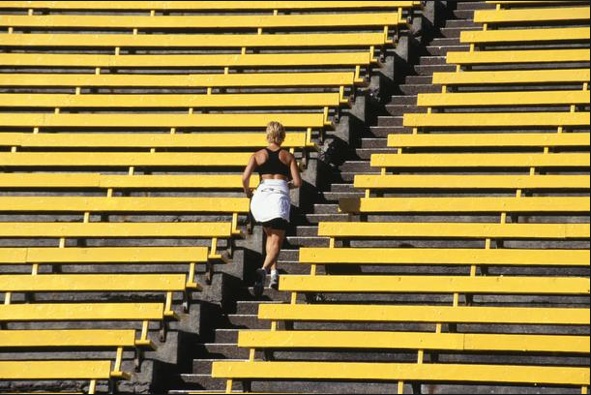
Run up one flight of stairs and your body will respond by elevating your heart rate and increasing your respiration rate, anticipating another flight while recovering from the past one.
Run up 25 flights of stairs, daily, and your body will increase your metabolic rate, shuffle nutrients into the muscles involved in the effort, increase the pumping volume of the left ventricle of your heart, and produce more endorphins, a group of hormones that interact with the opiate receptors in your brain to reduce your perception of pain and stress.
Your body will not adapt by increasing the size of your stomach, sharpen your eyesight, strengthen your shoulder muscles, or develop calluses on your hands. It only makes specific adaptations to the specific inputs you cause or allow.
You body is doing this all the time, awake and asleep, at work, at play, and especially at rest. It is one of the fundamental physical processes that is always occurring inside you, without your permission or control.
Our bodies have been created by evolution at an analog pace, by environmental factors that ebbed and flowed on our planet slowly through years, through eons. Consequently, our species has a nervous system specifically developed from interaction with our planet’s history, one that has helped us flee from predators, hunt as predators ourselves, and deliver bursts of energy during times of stress.
This energy producing aspect of our nervous system has been wired alongside a quieter part, one that functions as the conductor of our body’s processes during periods of rest, digest, and recovery from stress. Both sides evolved together as a whole, complementarily interacting with a slowly evolving world, seeking and maintaining balance behind the curtain of our day-to-day activities.
As a species we now find ourselves here, in our modern, no-longer-analog world, where the rest periods that used to be set by the years and seasons, and re-enforced by constraints of time, distance and traditions, are now shortened, the pauses devalued and almost entirely submerged under a tidal wave of cultural ‘multi-tasking’.
As our outside world has digitalized, it has moved beyond the old boundaries that were set by work hours, home life, landline telephones, and time zones. Things used to take ‘more time’…think of a relationship by snail mail, when one would receive a letter, compose a reply, send a return letter, and wait. In this process there was a whole lot of space and time, thinking time, feeling time, time alone in the middle of your life.
Modern technology has changed all that, has compressed the time, shrunk the space, and the quickened the tempo by which most people live their lives. Any debate about whether the change is for better or worse must respect the main point, that the world has moved on, and there is no going back.
It is a stimulating time to be alive, and quite possibly for our nervous systems, over stimulating. The physical wait times that still exist in our more populated world, time spent in traffic, or lines of people, can now be used as an opportunity to connect to the flow of information that is delivered directly to your psyche through your own personal communications device.
The ‘down’ time that used to be composed of sitting, sleeping, breathing, and just resting, disconnected from external stressors, is gone, and with it that old way of ‘naturally’ regulating our nervous systems. Gone, but in a physical sense, not forgotten.
Feeling states within your body affect the way you breath, and the way you breath can immediately affect the way you feel, creating a closed loop of stress causing stressed breathing, which creates more stress, until you are inordinately, and most completely, stressed.
Since you are always re-programming your brain and body through the actions you choose to repeat, as described in the post shown here: The Prime Enabler, then something that is repeated as often as your breathing has the potential to create not only an immediate effect, but also a long-term ‘state of mind’.
Martial artists, actors, singers, spies, and people who find themselves in high stress situations are taught a simple breathing technique to help them stay calm. It is the identical technique that is used in advanced meditation practice, when calming the body/mind becomes a pre-requisite for development.
The main issue with breath control and other body oriented techniques is that they work at a different pace than the mind oriented speed of normal life in the modern world. The most common mistake people make when approaching techniques and practices that are meant to create physical changes is that they ‘try it a few times, then move on’. Physical practices do not move at the ‘digital’ speed we have become accustomed to in our modern world.
They move more at the speed of the sun, moon, and seasons, continuous and unhurried.
Our human species also used to move at this speed, and our bodies developed their present forms and abilities in relation to that rhythm.To the modern human this calls for unusual patience, like waiting for an Internet connection on Dial-up. The important point being, you ‘get’ the physical changes at a speed that feels very slow, more like the changing of the tides than the turning on of a light.
Sit on the edge of a chair so that your spine is straight; place one hand on your chest and the other on your abdomen. When you take a deep breath in, the hand on your abdomen should rise higher than the one on your chest. This insures that the diaphragm is pulling air into the base of the lungs.
1. After exhaling through the nose, take a slow deep breath in through your nose for a count of 3 (or as long as you are able, not exceeding 3)
2. Slowly exhale through your nose for a count of 5. As all the air is released with relaxation, gently contract your abdominal muscles to completely push the remaining air from the lungs. It is important to remember that you deepen respiration not by inhaling more air but by completely exhaling it.
3. Repeat the cycle eight more times for a total of 9 deep breaths.
In general, exhalation should be longer than the inhalation. The use of the hands on the chest and abdomen are only needed to help you train your breathing. Once you feel comfortable with your ability to breathe into the abdomen, they are no longer needed.
Here is a video showing the technique, in this case the person demonstrating is sitting on the floor, we recommend sitting on the edge of a chair.
There are a million videos out there showing variations on this technique, most of them containing psycho-spiritual mumbo-jumbo and overly complicated instruction. The rule here is: Keep it Simple. Impose a simple demand on your body without a lot of mental links and it will make a simple, and in this case, an extremely worthwhile adaptation.
Once you have the basics to abdominal breathing to such a degree that you don’t have to use your hands on your torso for guidance, but can just feel whether you belly is moving in concert with your breath, it is time to ‘use it’ for effect in your life.
The next time you are in a stressful, frustrating, or boring situation, take a moment to focus your attention to your breathing. Chances are you will be ‘chest breathing’. Change your breathing to abdominal breathing by focusing on it for a minute or so. The change in your breathing will have a calming and centering effect on your body, and consequently, your emotions. This may sound too simple for belief, but this lowering of the breath from the upper chest to the lower abdomen is the primary technique for almost all ‘personal development’ methods. With a little practice, when it becomes your normal method of breathing, you will have a tool that is unused by most of the adult world.











 Strength and Resilience